Audience-First Creative System
One campaign idea. Relevant creative for every audience. Learning that compounds.
Media is planned and bought by audience. Creative should be built the same way. I created the Audience-First Creative System to help teams move beyond one broad message, give each audience a relevant reason to care, and make every campaign more useful to the one that follows.
Created and operationalized while Executive Creative Director at DELVE · 2026
My role:
System creator; executive creative leadership; audience and message framework; workflow design; cross-functional alignment; client storytelling; QA and final approval.
The problem
Audience precision is often lost at the final mile. Media teams create distinct audiences, then creative gives all of them essentially the same message. The result is less relevance, muddy testing, and very little reusable understanding of why someone responded.
Where they are × what they care about × why they act
Relationship status tells us how someone is connected to an organization. It does not tell us what they value or what will persuade them. The system treats motivation as a hypothesis to be made explicit, expressed cleanly in creative, and evaluated through response.
The five-step system
01
The Audience Brain
The Brain begins with evidence: deep research into the client and its market, combined with client-supplied brand guidelines, market research, historical performance data, and other relevant source material. I built the framework and multi-page prompt that guide AI in organizing those inputs into a first version of the audience strategy workbook. AI accelerates the synthesis and initial structure. Humans then review the draft against its sources, challenge assumptions, resolve gaps, refine the audience logic, and make final edits. The result is a human-reviewed strategic foundation for the work that follows.
Output: Audience strategy workbook
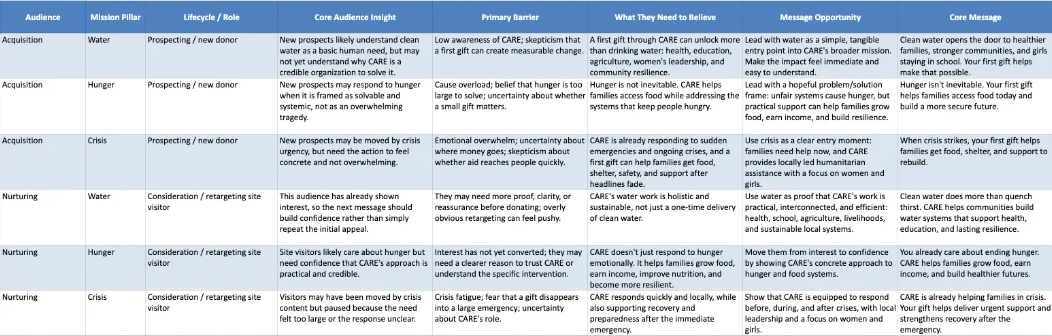
02
The Messaging Matrix
The Messaging Matrix brings the Brain together with the creative brief, brand guidelines, and relevant campaign inputs. Using the structured prompting framework I developed, AI creates a first draft of audience-specific message options and testing hypotheses. That first pass gives the team something concrete to evaluate and improve. Strategists and creatives check alignment with the brief and audience strategy, interrogate the hypotheses, edit for brand voice and clarity, and QA the messages before approval. Humans guide what the matrix says, what it tests, and what moves into production.
Output: Approved messaging plan

03
Modular Creative
Build one coherent campaign system that can carry audience-specific hooks, proof, imagery, offers, and calls to action across display, social, and video.
The display ad below illustrates the modular logic. The same framework can guide modular video, paid social creative, and assets for other channels. Each execution adapts to its format while drawing from the same audience strategy and approved messaging.
Output: Versioned creative set
The right parts change by audience
CHANGES BY AUDIENCE
Image. A real photo from CARE’s response.
Emergency line. Shown only on certain versions.
Headline. The message’s main line.
Supporting copy. One or two lines that back it up.
Call to action. Donate Now.

1
2
3
4
5
CARE’s display template
STAYS CONSISTENT
Layout & structure
Brand & logo
Visual system
Measurement approach
One approved template supports multiple audience-specific versions.
One framework. Channel-specific execution.
For video, modules can include opening hooks, scene sequences, on-screen text, end cards, and calls to action. For social, they can include imagery, headlines, post copy, and carousel sequences. The framework can guide any channel’s assets, with production methods and QA adapted to the placement.
04
Performance Signals
Connect audience, message, targeting, and creative identifiers so results stay traceable to the version that produced them.
Output: Performance readout by audience and message
05
Learning Returns
Review the results with human judgment, distinguish a signal from a pattern, and write validated learning back into the Audience Brain.
Output: A smarter starting point for the next campaign
What changes
Relevance: each audience receives an opening written for where they are, not where the average sits. Structured learning: every meaningful variation is tied to a question, not simply rotated for novelty. Range without rework: approved templates and message structures extend to new audiences without rebuilding the campaign. Traceability: naming, keys, feeds, placements, and reporting preserve the audience-message connection. Institutional memory: learning is recorded in a shared source of truth rather than left inside a platform or presentation.
AI accelerates the first pass. Humans shape the final work.
I designed the framework around a deliberate division of work. AI helps process extensive source material, organize evidence, and produce structured first drafts. People bring the strategic judgment, creative direction, context, and accountability needed to turn those drafts into work worth making. My contribution is the system around that exchange: the research inputs, workbook structure, multi-page prompts, review stages, and QA standards that make the process repeatable. The value comes from connecting these parts into a working creative practice.
AI ACCELERATES
Synthesis of research and client source files
Initial structure and drafting of the Brain
First-pass messaging options and hypotheses
Controlled variation, documentation, and QA support
HUMANS OWN
Source validation and interpretation
Audience strategy and hypothesis review
Concepts, brand voice, and creative judgment
Final edits, QA, and approval
The operational model
The system connects Client Advisory, Strategy, Creative, Design, Creative Development, Media, Measurement, and client stakeholders through clear inputs, decisions, handoffs, identifiers, and QA gates.
How the Workflow Connects
Shared inputs and working documents
Client research, brand guidelines, historical performance, and campaign briefs inform the Audience Brain and Messaging Matrix. These documents connect audience understanding to the messages the team approves for production.
Human review at each handoff
AI-generated drafts are reviewed against source material, refined for strategic and brand alignment, and approved before moving forward. Clear ownership and QA gates connect strategy, creative, production, media, and measurement.
Traceable production and learning
Audience and message identifiers connect approved variations to creative assets, placements, and reporting. That connection helps teams understand what was tested and return validated learning to the Brain.
Built around existing tools
The system was designed to work through strategy workbooks, messaging matrices, modular templates, shared documentation, and activation tools including Google Studio, CM360, DV360, and paid social platforms.
What efficiency means here
Efficiency starts before asset production. Research, source review, audience organization, and first-pass messaging all require substantial effort. The framework uses AI to accelerate that groundwork so people can concentrate more of their attention on strategic choices, creative quality, and refinement. Approved structures can then be reused across campaigns. The Brain carries knowledge forward, the Messaging Matrix organizes the next set of hypotheses, and modular templates translate approved messaging into creative variations. This reduces repeated setup and gives teams a more consistent starting point.
Built with further automation in mind
The structured inputs, repeatable prompts, and defined review stages also create opportunities for further automation. Preparing inputs, moving approved information between stages, generating controlled variations, and supporting routine checks are potential areas for development. Human review and approval remain explicit gates as those capabilities evolve.
Proof of application
CARE became the first full implementation. IFAW and UNFPA were moving into the system when my time at DELVE ended. Blood Cancer United and UNICEF demonstrate the dynamic-production and creative-discipline foundation that helped make this approach practical.