How I lead
See it early. Rank it. Make the call.
I run creative as a business: every problem gets ranked, decided, and owned.
These are habits, not software. They work in a weekly meeting with a spreadsheet as well as in a dashboard. To show the thinking, I built Creative Leadership HQ, a working prototype with a fictional agency.
Simulated data · a fictional sample agency
The prototype is best on a desktop screen.
Decide nowSample
Design is booked at 108% for the next 4 weeks
Five designers are over 105%. The Design Lead role has been open 74 days.
- Impact
- 5 designers overbooked
- Owner
- Head of Design
- Act by
- Oct 23
- in 6 days
The easy answer: Approve freelance cover for the peak and move non‑urgent work past Thanksgiving.
My call This isn’t a peak: design is over capacity in all of the next 8 weeks. Cover the next 4 with freelance, shift production work to junior designers, and make the Design Lead hire this week.
Grounded in what I’ve done
The job behind the thinking.
At DELVE I led the creative department from 2019 to 2026: a distributed team of 15 and the department’s P&L, including scoping, forecasting, staffing, capacity planning, and margin discipline. The prototype shows how I think about that job, using a larger, fictional agency.
01 · See it early
What a creative leader needs to see on Monday.
Four questions, and where each answer comes from.
- FinanceAre we profitable?Revenue against plan and contribution margin, by account and by team.
- MediaIs the work working?Test results, concept hit rate, and which winners are wearing out.
- ResourcingIs the team stretched?Bookings for the next 8 weeks by person, open roles, and freelance spend.
- CRMAre our clients staying?Client health, renewal dates, and the pipeline behind them.
02 · Rank it
How I decide what’s urgent.
Stakes first, then the clock. “Decide now” means high stakes and a window that closes within 10 days.
- Every problem has an owner. Nothing waits in a shared inbox.
- Every problem ends in an action, not a chart.
- Act-by dates count back from the deadline, leaving time to respond.
- Urgency is visible. Red means decide now, amber means soon, gray means watch.
03 · Make the call
Craft and the P&L in the same sentence.
Three sample decisions, and the judgment behind each one.
ProfitabilitySample
A happy client running at 22% margin
22%margin vs 40% target
$212kcontribution gap a year
Owner Account Lead
The easy answer: Keep absorbing the extra volume. The client is happy.
My call: Volume has run 38% over contracted scope since August. Re-tier at the next quarterly review.
A happy client isn’t a reason to under-price the work. Fix it early, with the numbers in hand, so the work doesn’t get thinner to cover the gap.
Creative effectivenessSample
Three winning concepts are wearing out
−22%hook rate on the top winner in 21 days
33%of spend on that one concept
Owner Senior Creative Strategist
The easy answer: Retire all three and start fresh.
My call: Refresh hooks on proven concepts before they fade, and reuse what the test log says works.
Don’t throw away a winning idea because one execution tired. Keep the concept, change the way in.
Team and hiringSample
A growth hire is stuck in the final round
67 daysSenior Strategist role open
3final-round candidates
Owner Me
The easy answer: Keep interviewing until someone feels perfect.
My call: Choose this week. The role carries strategy on two growth accounts, and the final round is complete.
Hire for the work you’re winning, not the work you had. A slow yes costs more than a clear no.
About the prototype
Walk through Creative Leadership HQ.
The prototype puts these habits in one place. AI does the prep; the judgment and the call stay with people.
Accounts viewSample data
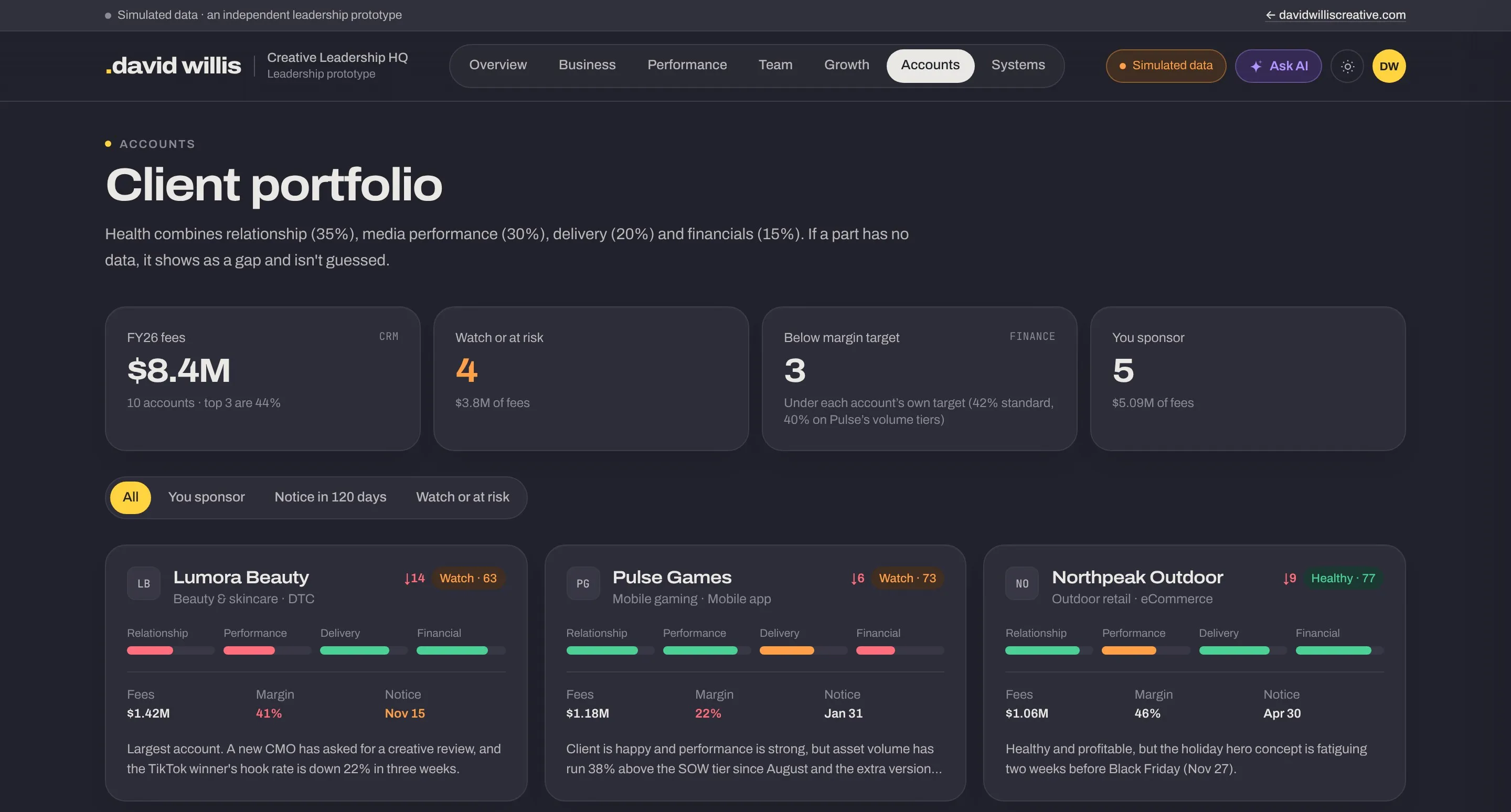
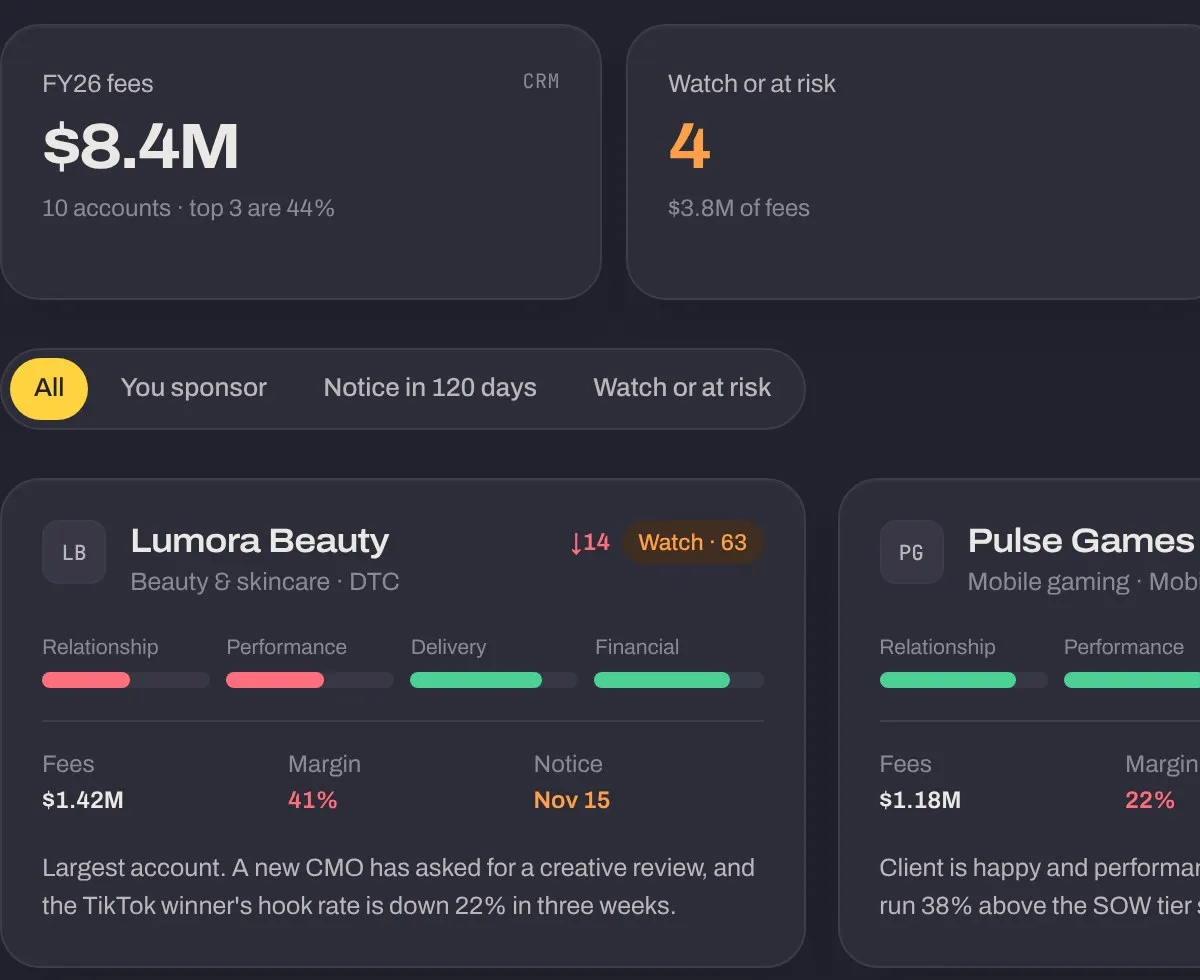
Seven views to explore on your own, or a six‑stop guided tour.
What’s real and what’s simulated
I set the requirements and the approach; AI‑assisted development helped me build it. The clients and numbers are made up. The calculations and the rules really run.
| Part of the prototype | Status | How it works |
|---|---|---|
| Finance, resourcing, people, production, media, and client feeds | Simulated | Sample data shaped like each real feed. No live integration. |
| Decision rules and priorities | Working | Rules check the data each time a page opens and rank what needs a call. |
| Forecast planner and quote builder | Working | Calculators over the sample P&L and pricing. |
| Reading meeting transcripts, notes, and reports | Working | Rules read and analyze files in the browser. |
| Ask AI | Demo | Answers are built from the sample data with rules. No AI model is connected. |
A dashboard keeps the record. It can’t make anyone better at the job.
The prototype tracks who owns what, what was decided, and what’s due next. It can’t tell me who’s stuck, who’s ready for more, or what someone needs to hear. Those answers come from talking with people, honestly and often.
The people side
Show how. Practice together. Then trust them with it.
Every call on this page needs someone ready to own it. Growth belongs to the person doing it, whatever their role. My part is to show how I handle the hard parts of the job, give people a safe place to practice, and then trust them with the real thing.
Show my thinking.
I show how I approach feedback, creative reviews, client presentations, and hard conversations, and why I do it that way. People take away practices they can adapt, not rules to copy.
Practice before it counts.
We rehearse the client presentation or the hard conversation together, with specific feedback before anyone walks in. Skill and confidence grow together.
Be a steady sounding board.
Regular one-on-ones to get ready for what’s coming, think through what’s tough, and look back on the calls people made. The aim is for each person to find their own way of working.
Be clear when it isn’t working.
Candid feedback early, and clear expectations. When someone is off track, we make a plan together. Nobody should be surprised at a review.
Trust runs both ways. When people can tell me what’s hard, I can be candid with them, including about what’s hard for me. That’s what makes the feedback land.
What it’s looked like: a senior designer with no direct reports grew into a team lead with a team of their own. Several junior designers grew into mid-level roles, and one into a senior designer. A junior developer grew into a team lead. Then I coached those leads to grow their own people into promotions.
How I know it works: the people I’ve developed start doing the same for the next person.
The habits on this page keep the business honest: problems surface early, the stakes set the order, and every call has a name on it.But the part I care about most is the people doing the owning. My job is to make them better at those calls, until they’re making them without me.
For Executive Creative Director and VP of Creative searches
Strong creative leadership should improve more than the next campaign.
It should improve how teams think, work, learn, and make decisions together. I’m open to local, hybrid, or remote ECD and VP of Creative roles.
Looking for a creative leader who can strengthen the work and the system behind it?